Tuesday, December 30, 2008

Let It Breathe

http://www.geocities.com/sax411/sax/saxophonists/charlieparker.jpg


What makes a jazz solo great? Why do musicians keep coming back to certain master players for inspiration in developing their own skills and style? Is there any single quality common to the most admired (and most transcribed) solos in the jazz tradition?

Rhythm, whether it is a sense of swing or groove or an individual player's use of rhythmic elements, is crucial, of course. Note choices (the "melody" or pitch content) is also critically important. Dynamics, articulation, style... all of these factors contribute to the overall quality of a jazz performance. But I would argue that none of these elements, taken separately, inevitably makes for a great, memorable solo.

It seems to me that, to be effective in a deep way, a solo must breathe. There must be a dynamic sense of phrasing where all of the individual musical elements converge in a convincing way. The oft-mentioned balance between the expected and the unexpected is certainly a part of this, but it is more than toying with the listener's expectations that gives a solo that certain something that makes it all but unforgettable.

The music must breathe. There must be a sense of line, of phrase, a certain elegance and balance. Horn players have a bit of an advantage in accomplishing this goal. After all, one must literally breathe to operate brass and woodwind instruments! Rhythm instruments can be played continuously, no "stopping" to breathe is necessary.

Of course, letting the music breathe is not just a matter of physical necessity. When you think of a great tune, classical piece or jazz solo is it possible to grasp it as a whole? It seems to me that we recall music in chunks or phrases that stick with us and, when put in context, somehow hang together with a feeling of inevitability. It is almost as if the piece HAD to unfold the way it did for it to make such a powerful impression.

As I write this I keep hearing Donna Lee in my mind's ear. That tune has a marvelous shape; it breathes in exactly the way I'm trying to describe. Charlie Parker was a master of all of the elements of jazz improvisation (that is certainly stating the obvious!). But if you analyze his solos in terms of phrasing - where he plays, where he leaves space, the varied length of phrases he plays, the shapes of the lines he plays; his music breathes in such a masterful, elegant way. That sense of inevitability is most definitely present in many of his solos, and Donna Lee (essentially a composed solo on the changes to Back Home In Indiana) is a great example of this quality.

Jazz musicians spend a lot of time working on fundamentals - scales, arpeggios, transcribing, ear training etc. If you're reading this you no doubt know exactly what I'm talking about. Becoming an effective soloist with something to say takes a lot of effort and time.

Here's a suggestion for the coming year's practice sessions: put some of your attention on phrasing and breathing regardless of what instrument you play. Listen not only to the great instrumentalists but also to the great vocalists. Pay attention not only to when they breathe, but also why they chose to start or end a phrase where they did. Experiment with varying lengths of your phrases. You can do this while working on your fundamentals as well as when you're soloing.

Let it breathe.

R.I.P. Freddie Hubbard

Another jazz great joins the celestial jam session.


Tuesday, November 25, 2008

Nouveau Retro: Charlie Hunter Trio


Baboon Strength, the latest offering from Charlie Hunter, is a most curious CD. If Hunter was ever a "jazz" guitarist, he certainly doesn't demonstrate any of the characteristics one would associate with that description on this record. As soon as I started spinning it, I realized that I would not be evaluating this recording from a jazz perspective, even if I accord the genre a wide definition (which I do). Ain't nothin' jazzy about this music at all. And that's fine. Its an instrumental pop record, so I'll review it as such.

I find myself vacillating between boredom and a grudging admiration for the album's insouciance. My first impression of Baboon Strength was negative; I thought the writing was vapid, the bass playing weak, and the overall vibe of the record rather somnambulistic. When I read that Hunter plays a 7 string guitar, I was duly impressed that he plays bass lines with his thumb and everything else simultaneously. But that circus trick doesn't override the glaring sameness of many of the tracks.

Nice grooves, yes. Tony Mason is a great pocket drummer. Maybe this record ought to be under his name since the drums are mixed hotter than anything else on every track. Keyboardist Erik Deutsch "brought his 1970s Yamaha combo organ, Casiotone and Echoplex" to the session, according to Mr. Hunter's entry on his website. That adds up to some psychedelic sounds which live primarily in the roller rink zone. I did enjoy the Sun Ra-ish sounds he used on the title track, a boogaloo with a theme right out of a 60's detective TV show.

As I listened, the music started to grow on me, the way that certain Top 40 tunes get under your skin through repetition. I stopped listening for awhile and then came back to it. I wonder who this CD is for, besides the guitar geeks who must surely be wowed by Hunter's ability to play bass, rhythm and lead simultaneously. The music is not progressive in any way; there's no heavy improvising; they're not pushing against any particular musical boundaries. This group is a band in need of a strong vocalist or horn player to give the music a focus. Some of the grooves remind me of John Mayer's Trio, whose live CD Try is a far more successful project. Mayer's well-crafted tunes, plus his strong singing and playing, provide that band with a powerful organizing force - just the thing that's missing from Baboon Strength.

A batch of "decent songs" (as Hunter calls them), played with these old school funk grooves ala Booker T and the MGs does not a satisfying musical experience make. Here are three musicians making music that somehow adds up to less than the sum of their talents. This music functions well as quasi -ambient, low - impact background sound, if that's what you like. It feels very good, but doesn't sound like much.


Wednesday, November 12, 2008

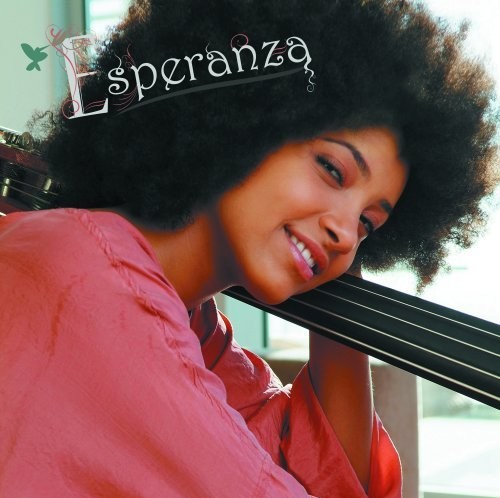
Esperanza!

http://www.smooth-jazz.de/firstview/Esperanza/Esperanza.jpg

The jazz hype machine (such as it is) went into overdrive earlier this year over Esperanza Spalding, the infuriatingly young and highly skilled bassist/vocalist/composer. She had features in Down Beat and Bass Player magazines, a nice piece on NPR, guest shots on David Letterman and Jimmy Kimmel Live etc. It is the kind of attention that many older, more obscure jazz musicians resent, often to the extent of ignoring an artist like her altogether (think Diana Krall).

Fortunately for Ms. Spalding, the quality of her work on this eponymous CD is outstanding in every way. I don't even care that she's young and attractive; no, not one bit of bitterness on my part. Not at all. I'm just thrilled that I got to use the word eponymous.

Anyway, this accomplished young musician composed nine of the twelve tracks on the album. Most of them have a latin-ish flavor; a couple are in odd or mixed meters. There's only one tune that has a little bit of straight ahead swing feel. The tunes are all well crafted, harmonically interesting and rhythmically strong. Some of the lyrics are a bit over the top sentimental for my taste, but that might just be the only indicator of Spalding's youth.

A majority of the tunes are bass-driven, which makes sense, given that the composer is a powerful bassist. It is easy to hear why so many heavy players have said positive things about her playing - and why she is on the Berklee faculty at such a tender age.

Last but not least, Esperanza can sing! She sounds effortless; she has a great sound and range; she sings with ease in English, Spanish and Portuguese.

Here's a little slice of a few of the tunes on this wonderful CD: